Bornbee Labs
Brooks Law: The Mythical Agent-Month
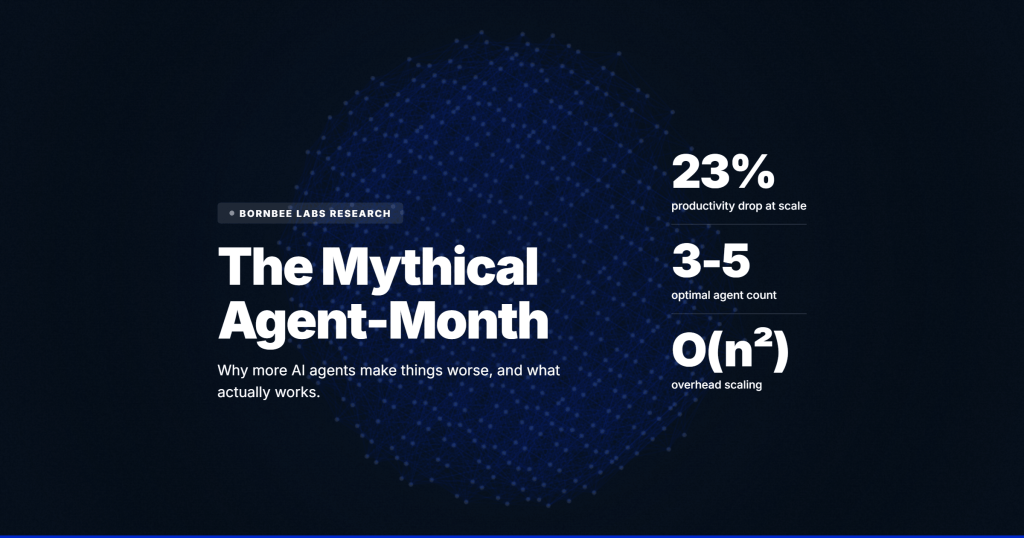
Everyone keeps adding more AI agents to their workflows. The assumption is simple: more agents, more throughput, better results. We tested that assumption with three computational experiments at Bornbee Labs. The results contradict what most teams believe.
Productivity does improve when you go from one agent to three. But it peaks between three and five agents. After that, it drops. At 15 agents, we measured a 23% decline in output quality compared to the 5-agent peak. Despite tripling the compute budget, we got worse results.
This is not a new idea. In 1975, Fred Brooks published The Mythical Man-Month, one of the most influential books in software engineering. His central argument: adding people to a late software project makes it later. The reason is coordination overhead. Every new person creates new communication channels, new handoff points, and new opportunities for misalignment. Fifty years later, the same principle applies to AI agents.
What we tested
We designed three computational experiments, each isolating a different aspect of multi-agent coordination. In every experiment, we scaled agent teams from 1 to 15 on identical coding and analysis tasks. We measured three things: output quality (correctness and completeness), coordination overhead (time spent on inter-agent communication vs. productive work), and total completion time.
The tasks were deliberately chosen to represent real-world complexity. They required decomposition, parallel execution, and integration of results. This is the exact scenario where multi-agent systems are supposed to shine.
What we found is that they do shine, but only up to a point. And that point arrives much sooner than most teams expect.
Three types of overhead that compound
The experiments revealed three distinct overhead categories. Each one grows as you add agents. Together, they create a compounding cost that eventually exceeds the benefit of parallelism.
Communication overhead: O(n²)
With n agents, the number of possible message pairs grows as n(n-1)/2. Three agents create 3 pairs. Five agents create 10 pairs. Ten agents create 45 pairs. Fifteen agents create 105 pairs.
Each pair represents a potential point of misalignment. Agent A assumes one data format. Agent B assumes another. Without explicit coordination, these assumptions diverge silently until integration fails. In our experiments, communication-related failures accounted for over 40% of all errors at team sizes above 10.
Synchronization overhead
Multi-agent systems often require agents to wait for each other. If Agent C depends on the output of Agent B, and Agent B is slow (due to complex reasoning, retries, or API latency), then Agent C sits idle.
As team size grows, the probability of at least one agent being slow approaches certainty. The system’s throughput becomes limited by the slowest agent at every stage. Our measurements showed synchronization wait times increasing linearly with team size, eating 18% of total wall-clock time at 10 agents and 31% at 15 agents.
Rework overhead
When multiple agents work on related components without tight coordination, their outputs conflict. One agent refactors a function signature. Another agent simultaneously writes code calling the old signature. A third agent documents the original interface. The result is broken integration that requires a reconciliation pass.
In our experiments, rework accounted for 15% to 30% of total agent compute time at team sizes above 8. This is compute spent undoing and redoing work, not producing net-new value. It is the AI equivalent of two developers editing the same file and creating merge conflicts.
The scaling curve
Combining all three overhead types, our data showed a consistent pattern across all three experiments.
| Agents | Relative output quality | Coordination overhead | Net productivity |
|---|---|---|---|
| 1 | Baseline (1.0x) | None | 1.0x |
| 3 | 2.4x | Low (8%) | 2.2x |
| 5 | 2.8x (peak) | Moderate (15%) | 2.4x (peak) |
| 8 | 2.5x | High (28%) | 1.8x |
| 10 | 2.3x | High (38%) | 1.4x |
| 15 | 2.1x | Very high (52%) | 1.0x |
The sweet spot sits at 3 to 5 agents. Beyond that, you are paying more in coordination cost than you are gaining in parallel work. At 15 agents, despite having 15x the compute capacity, net productivity dropped back to single-agent levels. Half the total compute was spent on coordination, not production.
This pattern mirrors Brooks’s original finding about human teams with remarkable precision. The shapes of the curves are nearly identical. The mechanisms are different (tokens vs. meetings), but the math is the same.
The practical framework
The solution is not to avoid multi-agent systems entirely. They do provide real value for complex tasks. The solution is to structure them differently.
Flat swarms, where every agent can communicate with every other agent, hit the O(n²) wall fast. Orchestrated architectures, where communication channels are deliberately limited, keep overhead linear.
Based on our experiments, we recommend a four-role architecture:
- Planner. Owns the objective, decomposes the task into independent subtasks, and writes the final integration plan. Only one planner per task. This role prevents the “everyone coordinates with everyone” problem by centralizing task decomposition.
- Specialist. Executes a specific subtask in isolation. Receives clear inputs from the planner, returns clear outputs. No direct communication with other specialists. This eliminates cross-agent interference and the rework that comes with it.
- Reviewer. Validates specialist output against the plan and catches integration issues before they compound. Acts as a quality gate between production and synthesis.
- Synthesizer. Combines validated specialist outputs into the final deliverable. Resolves any remaining conflicts using the planner’s integration plan as the source of truth.
This architecture limits communication channels dramatically. Instead of n(n-1)/2 pairs, each specialist only talks to the planner and reviewer. Three specialists in this structure create 6 communication channels, not 10. Fifteen specialists still only create 30 channels, not 105. The overhead grows linearly, not quadratically.
In our experiments, the orchestrated architecture achieved 89% of the output quality of the best flat-swarm configuration while using 40% less compute. The key insight: slightly less parallel work with much less coordination overhead produces better net results.
What this means for your business
If you are building AI systems with multiple agents, or planning to, here are three actionable takeaways from our research.
Start with one agent. Most tasks do not need a multi-agent system. A single well-prompted agent with access to the right tools outperforms a poorly coordinated team of ten. Only add agents when you have a clear bottleneck that parallelism solves, not because “multi-agent” sounds more advanced.
Cap your teams at 3 to 5 agents. If you do need multiple agents, keep the team small. The data is unambiguous: returns diminish rapidly after five agents. If the task requires more than five parallel workers, decompose it into smaller sub-tasks, each handled by its own small orchestrated team.
Use orchestration, not flat swarms. Never let every agent talk to every other agent. Use a planner-specialist-reviewer structure that keeps communication channels linear. The overhead difference between O(n) and O(n²) is the difference between a system that scales and one that collapses under its own coordination weight.
Why this matters now
The timing of this research is not accidental. Every major AI lab is pushing multi-agent frameworks. Open-source communities are building agent orchestration tools. Companies are deploying agent teams for customer service, code generation, data analysis, and content production.
The marketing message is consistent: more agents, more capability. And to be fair, multi-agent systems genuinely unlock capabilities that single agents cannot match. Complex tasks that require decomposition, specialized reasoning, and parallel execution benefit from well-structured agent teams.
But the critical word is “well-structured.” Without deliberate architecture, companies are deploying flat swarms that waste compute and produce inconsistent results. We have seen teams triple their agent count and then wonder why their outputs got worse instead of better. The answer is always the same: coordination overhead consumed the gains.
The hidden cost of coordination debt
There is a concept in software engineering called “technical debt”: shortcuts that save time now but create compounding costs later. Multi-agent systems create an analogous problem that we call “coordination debt.”
Every agent you add without restructuring your communication channels adds coordination debt. At first, the cost is invisible. Three agents coordinate easily. Five agents show minor friction. But at ten agents, the accumulated debt becomes the dominant cost in the system. You are spending more compute on agents talking to each other than on agents doing actual work.
The insidious part is that coordination debt does not show up in standard metrics. If you measure output volume, ten agents still produce more raw tokens than five. But if you measure output quality and net productivity (useful work per unit of compute), the picture reverses. Volume goes up. Value goes down.
This is why the 4-role orchestrated architecture works. It is not just a performance optimization. It is a structural solution to coordination debt. By limiting who talks to whom, you prevent the debt from accumulating in the first place.
Brooks wrote in 1975 that “adding manpower to a late software project makes it later.” Fifty years later, the same principle applies to AI agents. The teams that understand this will build systems that actually work. The teams that do not will spend their compute budget on coordination overhead instead of productive output.
Download the full technical report
This article summarizes our key findings. The complete technical report includes all three experimental designs, raw data tables, the full scaling curve analysis, and a detailed breakdown of the four-role orchestrated architecture with implementation guidance.
Build smarter, not bigger
We help teams design AI systems that actually scale. If you are building with multiple agents or planning to, we can help you find the architecture that works. Start with the report above, then reach out when you are ready to implement.